Tuesday, April 7, 2020

Presentation: "Cool" is what "Cool" isn't


I plan to use this presentation as a space to explore industry studies as a methodological approach rather than presenting on, or arguing for, a clip I select. Drawing inspiration from Holt, Caldwell, and other contemporary “industry study” scholars, I would like to consider the ways in which discourses and conditions around policymaking might influence the “critical industrial practice” of more globalized/international/transnational media industries, specifically Japan’s animation industry. However, I hope to focus on more contemporary histories rather than the vast history of Japanese animation and globalization. I’m specifically interested in two historical “moments”: 1) the contemporary and 2) the 90s-2012. What is it about these two periods and Japan’s animation industry? For myself, I am interested in the economic stagnation during 90’s and the global financial crisis of 2008-2009 and where “Japanese soft power” figured into it then, and how it fits into the conversation now. Most scholarship around Japanese animation have pinned the globalization processes, growth, and “current success” of Japan’s animation industry to the 80s/90s/00s/ “now” and describing the “Cool Japan” phenomenon. “Cool Japan” is an expression referring to Japan’s emergent and growing soft power but has recently become a branding mechanism for the government of Japan to mobilize and distribute their commercial and cultural capital beyond domestic borders. Therefore, instead of a clip, I hope to offer some insight into “Cool Japan” as a way for Japan’s animation industries to imagine themselves discursively and industrially, and how Japan’s METI have mobilized these discourses and strategies into a policy named after Cool Japan itself.

Methodologically, reflecting on the contemporary also allows us to reexamine some of the ways in which industry as such has been conceptualized or imagined not only through media scholarship but by the “industries” themselves. Some contemporary “industry scholars” have begun calling, what our readings have described, the “industry” as an “ecology” or media ecology, in order to think about the dynamism and vibrancy of industrial formations and configurations. (Zahlten 2017, Lamarre 2018). Although I currently don’t have any really developed thoughts or critical positions towards contributing towards scholarship about media industries/ecologies, thinking about the contemporary highlights some of the analytical and conceptual limits of more "traditional" approaches to industry studies. At the same time, focusing on the contemporary industries and approaches to industries allows us to trace the ways in which they developed historically and discursively. Holt sharply emphasizes the role of media industries at the time of her writing, citing Peter Bart: “a major player ‘must mobilize a vast array of global brands to command both content and distribution. Indeed, such an enterprise must be more than a company – it must be a virtual nation state.’” (Holt 11)

Certainly, that seems to be the case with Japan’s animation industry, in which one might conflate the industry to Japan’s national identity itself. There was recent controversy around the very popular series, My Hero Academia, where a character’s name drew immense criticism from China and South Korea. The controversy led to Chinese platforms Tencent and Bilibili removing both comic and animation from their libraries. This comes a couple of years after successful theatrical runs of Spirited Away (officially screened a decade past its initial release) and Your Name. Simply put, not only are these “enterprises” perceived as a virtual nation state, but they must “behave” as if they were a virtual nation state as well.


Enter Japan’s METI’s Cool Japan project. The project initially sought to meet the “global demand” of product that wasn’t as demanded domestically. The following image is taken from the initial 2012 draft of the Cool Japan project, tentatively titled Cool Japan Strategy:
Figure 1 (Cool Japan Strategy January 2012 draft)
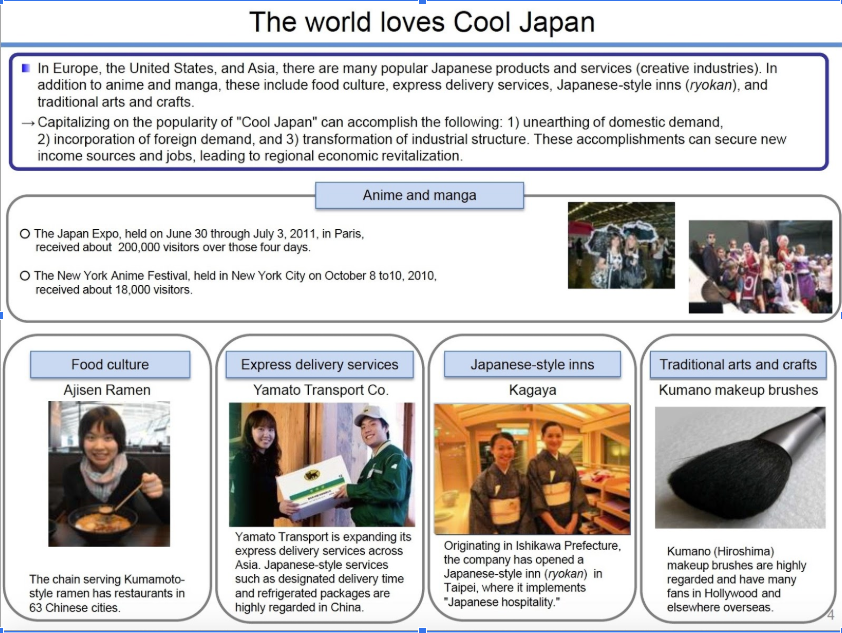

Whereas Cool Japan might have initially described medium specific things of Japan’s popular culture in the 90s and early 00’s (Allison 2006), this 2012 draft sought expanding Cool Japan into including more “aspects” of Japanese culture in order to develop creative industries elsewhere.
The following images from the same draft uses cartographic renderings of the “world” in which METI conceptualizes that world in terms of potential market points for the project and various creative industries:


Figure 2 (Top and bottom images are both from Cool Japan Strategy January 2012 draft)

I want to emphasize that the latter image presumes that the products/creative industries imagined within this global market are both desirable and assimilable. But more importantly, various combinations of products and industries are imagined in different markets: India and Italy are conceptualized as potential markets for fashion, food, design, and content, South Korea is food and regional product, France is listed with “town development” and “daily goods”, etc. There are many possible reasons for the different combinations of products and industries imagined for each market, such as: the market might already have a robust industry of that particular stuff, the market’s familiarity with Japanese product or culture is with this stuff and not that stuff, or certain political or economic relations allow for, or resist, certain things.

However, the “Cool Japan” strategy/policy/phenomenon is not the “first of its kind.” There have been other policies that sought similar efforts, such as Cool Britannia and the Cool Korea Strategy in 1997. And this brings me to some questions: what is the work of “Cool” and why target cultural product and creative industries?

Holt and Caldwell’s essays certainly provide models of analysis towards answering these questions. For Holt, policies are the discursive, material, and literal realizations of the relationships between industries and governments. I feel the same. Analyzing policies become a way to unpack how these relationships are configured and imagined. Yet this approach seems to gloss over the specificity of the products that do circulate—the stuff that sells—and why they circulate. Simply put, markets need to buy into the product you’re selling, it needs to appeal to them in whatever localized, regionalized, globalized way that allows those industries to “expand” and do their work. Recent studies show that Cool Japan is “failing”. The global market isn’t buying what Japan’s METI is selling, but that doesn’t mean that it’s not buying what the Japanese animation industry is producing. The recent 2019 annual report from the Association of Japanese Animators shows the sixth straight year of revenue growth earning an industry-wide 2.1814 trillion yen, or 10.939 billion dollars. Why the gap? Where can we locate the gap? What is the gap?

Caldwell’s work on the stunt-genre and critical industrial design, for me, provides one way into exploring this gap. If METI thought that Cool Japan was “this”, and has been enacted as “this”, but failing at “this”, while thinking all this time that "this" was “that,” then what are the differences between “this” and “that”? Is the Japanese animation industry, or some studios, doing "that"? Maybe it's something different from what Cool Japan meant initially during the 80s/90/s/early 00s. I personally feel that this question and related questions require similarly different answers that deploy the historical, textual, and conceptual approaches of all three readings for this week.

Historically, the economic stagnation of 2009 might have encouraged Japan’s METI to enact the policy 3 years after the global financial crisis, hoping that the “expansion” into the global market (again?) might bear the same fruit of some international economic success during Japan’s Lost Decade. The rising anti-Japanese rhetoric emerging into the global conversation from Japan’s imperial history from countries like China, South Korea, and Taiwan might have also forced Japan’s government to deploy “Cool Japan” as a means to deflect “Imperial Japan.” (Ching 2019)

Aesthetically, the appeal of Japanese animation continues to growth globally, or at the very least, the commercial appeal of it. Where is the appeal coming from? Koichi Iwabuchi suggests that it’s the lack of  “cultural odor”, 無国籍 , or "Japanese-ness" 日本人論  that allows for a globalized legibility for the non-Japanese market. (Iwabuchi 2002) Yet such assimilability seems to be conditional on past and present political and economic relations, such as the My Hero Academia controversy. So how can one locate, examine, or analyze that appeal which continues to commercially grow? For myself, one way into grappling with that appeal is through looking at representations of environment and space in isekai anime. Isekai (different world) is a fantasy subgenre of Japanese light novels, comic, anime, and video games that generally revolve around the protagonist transporting from Earth to another parallel universe. These parallel universes are typically depicted as a fantasy world, laden with iconographies of vast fantastical landscapes, characters, and object. How might these spatial aesthetics narrativize or characterize not just isekai anime or anime as such, but Japan’s animation industry as textually and commercially appealing to the non-Japanese market? What are the similarities and differences between representations of environments and spaces in isekai and other “genres”? Under what conditions does that appeal fail? 



Figure 3 (“Tokyo” in Your Name)

Figure 4 (Fantasy world in KonoSuba: God's Blessing on this Wonderful World!)

Figure 5 (Fantasy world in Log Horizon)

Conceptually, I continue to grapple with “industry.” I entered the CAMS program as an “industry scholar” but had no idea what that entailed in terms of “industry” as an object of analysis. I was faced with a lot of epistemological questions. At the end of the MA, I am confronted with a similar set of intellectual questions pertaining to approaches to, and definitions of, “industry.” It might be the division of labor, corporate strategy, annual sales reports, cultural policy, regulation, critical industrial design, or dynamic producer-consumer relationships. Ideally, I’d like to pitch a model that can address them all, yet I know that no one’s going to buy that.


Core Post 3: "Industry studies" isn't just convergence, but it's a big part of it


I really enjoyed this week’s batch of readings and how each piece approached the “industry.” For all three scholars, industry was described as some kind of infrastructural arrangement of production, distribution, and consumption: vertical integration for Holt, “convergence TV” / “culture of production” for Caldwell, “convergence” for Jenkins. Each approach to the industry offers different insights into how we might study industry.

Holt’s examination of the “regulatory climate” (Holt 14) allows her to trace the relationships between political philosophies, the marketplace, and media corporate organization. Holt concludes that the political philosophies behind broadcast deregulation beginning in the 70s was a prominent factor in determining “must see” TV, or at least what gets put on prime time. For Holt, prime-time TV as an aesthetic form or scheduling arrangement isn’t just a marketing tactic by discrete “vertically integrated entertainment conglomerates” but also products of government regulation and the industry as such.

Caldwell’s piece adds to the conversation by looking at how individual series are brokered and pitched within the new regulatory climate of different vertically integrated players that Holt describes. Whereas Holt focused on the historical and economic conditions determining TV’s industrial organization, Caldwell is interested in how these conditions necessitate certain changes in television’s textual forms. For Caldwell, the shifting modes of distribution due to both “vertical integration” and “television-Net convergence” requires practitioners to produce stuff that best fits how that stuff might move around in a dynamic set of industrial relations. He lists different aesthetic changes and strategies for how TV has “looked differently” because of the new industrial and regulatory landscape. I found his analysis of the “stunt genre” as both an industrial strategy and aesthetic of “television-Net convergence” compelling and convincing in his argument towards reconsidering “aesthetic analysis in television studies itself.” (Caldwell 44) At the end of the day, stuff has to be pitched and sold not only to “producers” but “consumers” as well. For Caldwell, the stunt-genre becomes a way to examine how the “culture of production” behind convergence TV gets to go on-air, and why it can be “articulated,” “revised,” and “rearticulated” by consumers as well as other industrial players. People simply liked it/bought into it in different ways, and Caldwell shows how the text’s form appeals to these different players.

Jenkins’ piece bookends the batch of readings by offering a conceptual account of convergence and its implications/consequences for the relationships between producers and consumers. If Holt and Caldwell provided historical accounts of vertical integration and convergence TV, describing past and contemporary events, then Jenkins could be understood as prescribing convergence as both a historical account (e.g. how are these new materials regulated and regulated through what platforms or infrastructures?) and conceptual model (e.g. where might the “agency” lie between producers and consumers? Who has “ownership”?) for media studies. For Jenkins, convergence is not just industrial organization, or the produced aesthetics demanded by the industrial arrangement of different media corporations, but the ways in which he argues that consumers can, and have, leveraged their “emerging power through new collaborations with media producers.” (Jenkins 36) Thus, I might trace the shifting emphases across the readings, from Holt’s thorough historical account, Caldwell’s historical and textual analysis, and Jenkins’ historical and conceptual frameworks and conclude that the dynamism of media industries requires a similarly interdisciplinary approach towards studying industries as such.

Monday, April 6, 2020

TV and passover seder

The Morley article takes the passover seder as an illustration of the concept of the hugeness of an audience being transposed into an intimate register. Ryan and Katz imply that, in the same fashion, disperesed TV audiences are reunited in the home by means of diasporic ceremony, whereby attendance takes place in small groups.
I can see how this holds in terms of the transmission of a top down message. But I see a core limit to this comparison.
A Passover seder is a matter of tell the same millennial story every single year and to discuss how its lessons and values are relevant at the present moment. I think that's the complete opposite of the idea of gathering to absorb new content on TV, which aims at bringing new, exciting, current entertainment to audiences. By "new" I mean "already optimized for its current audience." The audience is exposed to a message that is buried in layers of current-day communication trappings in. In other words, the "new"content, whether it vehicles new or time-old ideas, packaged in an optimized and attractive manner, reflects its emitter (which/who has a targeted agenda).
The Passover seder is the opposite paradigm: it consists in taking a time-old message (unattractive, seemingly passe' etc) and in discussing how it is relevant in the present moment.


Core Post: Producers as authors


I’m compelled by several aspects of Caldwell’s stab at a “critical industrial studies” version of television’s post-convergence forms. His scrutiny the ubiquitous term “content” to refer to media texts; the expansion of traditional textual analysis to account also for the industry ‘at large’; his granular look at the many ways in which production cultures affect televisual texts; Caldwell incorporates all of this and more in this chapter informed by what he refers to in passing as a Geertzian method. And it’s this invocation of anthropology that most interests me. Geertz is perhaps most well known for his contributions to interpretive anthropology and its emphasis on thick description, a particularly fine-grained mode of ethnography. Caldwell’s piece is clearly neither ethnography nor thick description – but it does suggest how such approaches might be put to work in media studies. 

This is most apparent in his (stellar, stimulating) discussion of specific aspects of the production process such as pitching and writers’ rooms. His discussion is compressed and cursory, distilling information gleaned from trade journals and tabloids into astute insights about the terms in which aesthetic decision-making gets done in a producorial capacity. The potential for an ethnographically richer appraisal of TV’s producer function is clear. Even in the compressed form of analysis that Caldwell offers, a number of refreshing gains are made towards the project of linking analysis of televisual form in actual “communities and cultures of production.” His discussion of pitching establishes the authorial function of producing that has so often been neglected. Anyone who was worked, however tangentially, in film/TV production knows that texts are made long before the first frame has been filmed. A continuous stream of discourse – in the form of script coverage, pitch meetings, the back and forth of drafts and rewrites – inserts the producer into the text, bestowing on them an authorial function, even though the trace of their presence will go unmarked in the final text that airs. Cultures of production, as Caldwell brilliantly notes, are not incidental to TV form; they are basic to it.

A Pandemic, but Have It Your Way


Since coming home, I've been doing much more TV-viewing in the 'classical' sense and within a few hours I had already seen this ad several times. So quickly, the proper steps to take in the midst of a pandemic have been commodified, and I cannot help but to wonder if such safety measures will continue to be central to food-based advertising once the virus has subsided. This is merely one way in which the televisual landscape shows signs of being forever changed by the current state of things.

Presentation: Networks, streaming, branding, and you

Though Jennifer Holt wrote her "Vertical Vision: Deregulation, Industrial Economy, and Prime-Time Design" article in 2003, things like media consolidation and industrial interests are definitely still around. Within the last year alone we’ve seen 20th Century Fox’s holdings recede into the “Disney Vault” as part of a merger between the two behemoths. Self-dealing continues to be the subject of many of lawsuits, not least of which with the highest rated show on TV, in the case of AMC with The Walking Dead.

But in the years since her article came out, our understanding of what constitutes “network” and “ownership” has drastically shifted. Now that the industry is more awake to the online/streaming preference of most consumers, we are now going to perhaps better understand where our content is actually coming from. As Holt note in her piece, it wasn’t (and, probably, isn’t) uncommon for viewers to be unaware how many corporations have their hands in a single show:

For example, currently Warner Bros. (or a subsidiary) is producing ER, Friends and The West Wing for NBC rather than funneling these programmes directly to their own WB Network. Fox Television produces two of ABC’s most popular programmes, Dharma & Greg and The Practice, CBS’s Judging Amy, as well as one of WB’s flagship hits: buggy the Vampire Slayer.
… Disney still sells Felicity and Popular to WB instead of to their subsidiary ABC, and Paramount Television is producing two hits for CBS rivals — Frasier for NBC and Sabrina for WB.  

But it’s become something that those behind the scenes are increasingly paying attention to, especially as the “willed affinity” that John Caldwell alludes to in his article “Convergence Television.”

Far from monolithic, the television industry is actually comprised of many very different local industries locked into a world of ‘willed affinity.’ This affinity stands as a convenient common front for ‘the industry’ only as long as business relations can guarantee stable markets and economies of scale.

At first, networks were fine seeing streaming platforms (then mostly Hulu, Netflix, and maybe Amazon Prime) as an extension of themselves for the sake of willed affinity. Television had always been done on the cheap, always looking for easy ways to repurpose and recycle. Why not see if your show could find an audience on a streaming platform — heck, you might even hit it big and see a boost in ratings/notoriety, as is the case with the likes of Breaking Bad, Riverdale, and The Good Place.


I thought of this 30 Rock clip many times during this week's readings, not only because they discuss vertical integration in detail, but because it shows what networks were preoccupied with around the time (shortly after) that both Caldwell and Holt were writing. 

But because of the ease that came with utilizing online sites as an outlet, many “established” networks were caught behind on the streaming game. It took until the late aughts for them to wake up and smell the accessibility that emphasizing online platforms gave them. And during that time Netflix had actually successfully built a platform akin to “something for everyone,” if such a thing was possible. Sure they lacked a lot, but in terms of TV they made it simple, intuitive, and easy to watch on and on and on.

Everything about Netflix’s strategy seemed intent on building off of what they’d learned from years of audiences bingeing television on their service, flouting the established rules of television. They dropped TV shows in the traditional off-periods, like Fridays, holiday seasons, or summertime. Their productions were alternately grand and specific, focusing on communities not often seen on TV. And though Slate’s Willa Paskin commented at the time that AMC’s careful eking out of Breaking Bad over several years contributed to the “pent-up demand for more episodes” that Netflix could harness — a demand the platform “can never quite foster for itself” because of its release structure — Netflix leaned into binge mode, dropping every show all at once. Netflix had genericized show after show, all while building up a legitimate competition to the brands in question.

So networks started to built within, not just out. And what we’re faced with now is a shift in how audiences and providers alike will think of their content as a “brand.” Audience may have to understand better where they’ll be able to find their favorite shows, since now they’re being brought to “in-house” streaming services rather than just farmed out to the highest bidder.* By having their own streaming service, companies can further develop their “brand,” while cashing in on the viewers who want to be endlessly streaming (and restreaming) their shows, but they need to think strategically about how to actually make that service appealing in a period with a glut of streaming platforms all clamoring for our money and eyeballs. (Or, at least, we hope.)

Some services have already started doing this: Disney, never one to miss out on opportunity to really underscore their brand, now strategizes its content across Disney+ (with a focus of: family-friendly) and Hulu (more adult, established, shows, especially from the Fox side of the productions). Others are banking on the IP that has already proved to be a lucrative commodity in the streaming landscape to be enough of a brand name for them: NBC’s Peacock will get exclusive rights to The Office, which has found a second life among streaming.

Creators aren’t immune either. In the 17 years since Holt’s article came out, more and more networks have brought their production in-house. While it may have been done in some cases out of sheer necessity (the aforementioned AMC started making shows because they couldn’t find people to partner with) it’s also because by creating a studio to produce original series, networks were benefitting from a multi-revenue stream business for each show. With AMC Productions responsible for The Walking Dead, AMC could benefit from:
-       Increased advertising rates (from the massive ratings it raked in)
-       The sale of The Walking Dead to any “syndication” offers, whether overseas (like Lovefilm in the U.K.) or online (Netflix’s Canada and U.S. libraries)

Even services like Netflix have to move on to a new phase of being — after all, a different sort of “willed affinity” is on the parts of all of us, who think of it as just an extension of what we understand a network/production house/entertainment conglomerate. Over the next few years we’re going to get a better understanding of what is a viable business and what isn’t in this new format of television. The answer to that isn’t consistent for Netflix, in the same way it isn’t (and certainly hasn’t been) for the networks themselves.

As brands shift, perhaps the most interesting thing will be how we value a single television show. It’s no longer enough to make up a certain amount of ad or syndication revenue, the lines that used to clearly demarcate appropriate and inappropriate vertical and horizontal integration are increasingly blurring. As Amanda Lotz writes in We Now Disrupt this Broadcast: “Did it matter how many viewed it in the days, weeks, or months immediately following its release? How do we assess the value of a show that becomes part of a library in perpetuity?”  

*For fun: here’s a quiz about where your shows are headed in the next year as streaming services continue to open their digital doors. Can you pass? Click to expand if you want to just take it here on the site (assuming I posted this right). 

Media convergence is the moment... But maybe not always? (Core Post #5)

I really liked Henry Jenkins’ “The Cultural Logic of Media Convergence” for how it discussed media convergence in terms of a flow and an ongoing process, as well as the active participation of consumers within media convergence. I think a big issue that not only media conglomerates, but also internet creators, have always had with media convergence is adapting the content to fit different mediums. Jenkins addressed some of this on page 37, “Each time [media conglomerates] move a viewer from, say, television to the internet, there is a risk that the consumer may not return. Sometimes media executives are thinking across media; sometimes they can’t extract themselves from medium-specific paradigms”. This is interesting to me because it is not only a risk for traditional media, but also for online media creators (surprisingly).

We assume that internet creators are more versatile and can easily adapt to different mediums, but there have been many instances when that didn’t work out so well. Comedian and YouTuber Grace Helbig got a deal with E! to bring her YouTube channel to television in “The Grace Helbig Show”. While it was exciting to see a big YouTuber enter the more respectable medium of TV as an official “talk-show” host with A-list celebrities, the humor, style and aesthetics that worked for Helbig so well on line, did not translate to TV. The show’s ratings were so bad that even E! shaded the creator after the show got canceled. Colleen Ballinger (a.k.a. Miranda Sings) is another YouTuber who got her own Netflix show, but it wasn’t received very well. As Deadline reported: “Haters Back Off got off a solid start […], earning a second-year renewal, but in the long run, Ballinger’s huge YouTube following did not quite translate into streaming audience for her Netflix series.” This all made me think about how both media executives and creators still struggle to deal with media convergence, as it isn’t just about shifting to new mediums, but also a shift in content. Not everything translates well to every medium, so although media convergence is our reality, maybe we don’t need to push it so strongly? It’s still ok to stay within one medium.

Jenkins’ discussion on media convergence being “both a top-down corporate-driven process and a bottom-up consumer-driven process” (37) also feels extremely relevant today. TikTok has slowly been gaining some respect within the online community and the way it has been able to generate pop music hits really sky-rocketed the platform and displayed what Jenkins talked about. After including the viral TikTok dance (and its creator) in her music video for Say So, Doja Cat got 15 million views on the video’s first week. The app also made Kesha’s 10-year-old song Cannibal go viral, prompting the singer to release a brand-new lyric video for it.

So yes, media convergence is the moment, but maybe it doesn’t always have to be? If the audience doesn’t ask for it, it might be better to stay within one medium and not risk the ruining the content. I think creators and media conglomerates are starting to understand this, especially since we’ve (thankfully) seen a decline in YouTuber-lead fiction shows on YouTube red… Bless their souls.